

How to Select the Right Solar Controller for Your Solar Power System
A solar controller is a critical component in a solar power system, responsible for managing the battery charging process, preventing overcharging or deep discharging, and ensuring the system operates safely and efficiently. This guide will help you choose the right solar controller for your needs.
1. Understand the Types of Solar Controllers
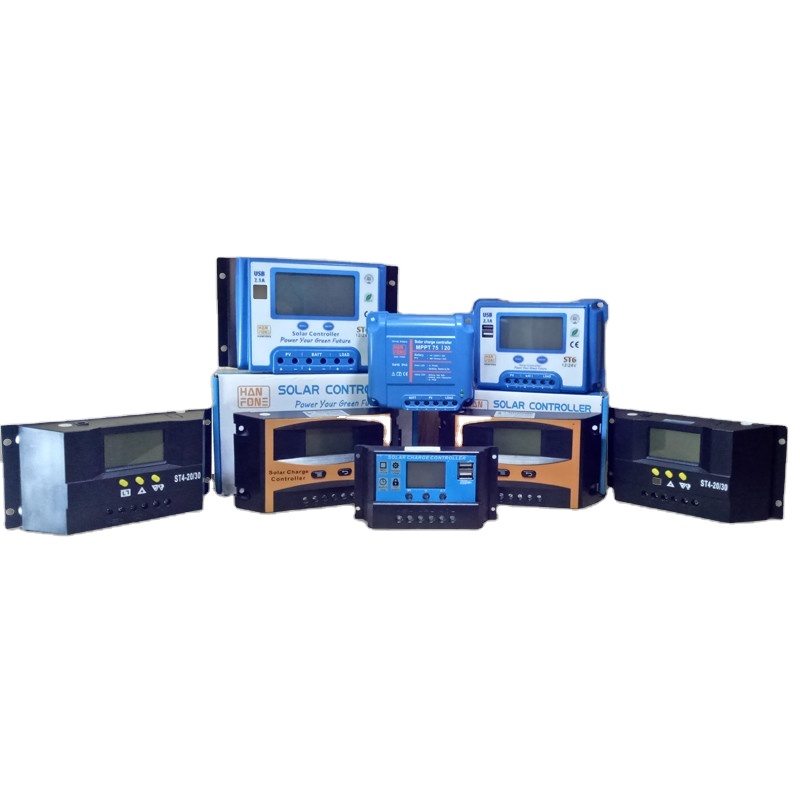
There are two main types of solar controllers: PWM (Pulse Width Modulation) and MPPT (Maximum Power Point Tracking).
PWM Controllers: Ideal for small-scale solar systems, PWM controllers are cost-effective but less efficient. They regulate the battery charging voltage by rapidly switching the solar panel’s output, making them suitable for systems where the solar panel and battery voltages are closely matched. In our company’s product lineup, we offer PWM controllers in the ST6 series, ST7 series, and SR series, with current ratings ranging from 10A to 60A, catering to a variety of system sizes and requirements.
MPPT Controllers: Best for medium to large solar systems, MPPT controllers are highly efficient. They convert the solar panel’s output voltage to the optimal charging voltage for the battery, maximizing energy harvest. While more expensive, they are often more cost-effective in complex or larger systems. Our company provides MPPT controllers in the SMP series, with models ranging from SMP-10A to SMP-80A, ensuring compatibility with a wide range of solar power setups.
By understanding the differences between PWM and MPPT controllers and exploring our product offerings, you can select the right controller to optimize your solar power system’s performance.
2. Determine System Voltage and Current
When selecting a solar controller, it’s essential to match the system’s voltage and current requirements. The controller’s rated voltage and current must align with the specifications of your solar panels and batteries. Common system voltages include 12V, 24V, and 48V.
Voltage Compatibility: Ensure the controller’s input voltage range is compatible with the solar panel’s output voltage.
Current Compatibility: The controller’s rated current should be equal to or greater than the solar panel’s short-circuit current (Isc) to avoid overloading.
3. Consider Battery Type
Different battery types (e.g., lead-acid, lithium-ion) have specific charging requirements. Choose a controller that supports your battery type and provides the appropriate charging algorithm.
Lead-Acid Batteries: Commonly used in solar systems, these require controllers that support bulk, absorption, and float charging stages.
Lithium-Ion Batteries: These batteries demand precise voltage control and protection features, so ensure the controller is compatible with lithium-ion technology.
4. Evaluate Environmental Conditions
The operating environment can significantly impact the controller’s performance and lifespan. In harsh conditions such as high temperatures, humidity, or dusty areas, opt for controllers with robust thermal management and protection features.
Temperature Range: Verify that the controller’s operating temperature range suits your installation environment.
Protection Rating: Choose controllers with a high IP (Ingress Protection) rating to withstand dust and moisture.
5. Additional Features
Modern solar controllers often come with advanced features to enhance system performance and user experience. One such feature is an LCD display, which provides real-time system data such as voltage, current, and charging status. This allows users to monitor the system’s performance at a glance and make informed decisions about its operation. When selecting a controller, consider these features to ensure it meets your specific needs and enhances the overall efficiency of your solar power system.
6. Budget and Cost-Effectiveness
Finally, balance your budget with the controller’s features and performance. While MPPT controllers are more expensive, their higher efficiency often justifies the cost in larger systems by delivering long-term energy savings.
Our products: PWM Solar Charger Controller, MPPT Solar Charger Controller, Digital Display Controller and so on.
